
Fish oil and omega-3 are related terms, but they do not mean the same thing. Fish oil is an ingredient source. Omega-3 describes a family of fatty acids, including EPA, DHA and ALA. A useful comparison starts with the amounts of EPA and DHA listed for a defined serving—not the largest number on the bottle.
This guide explains how to compare labels without confusing total oil weight, individual fatty acids, capsule count or research doses. It is educational information, not a personalized dosing recommendation.
Fish oil is a source; EPA and DHA are components
Fish oil supplements can supply EPA and DHA in different amounts. A product name such as “fish oil” identifies the source category but does not by itself tell you how much EPA or DHA a serving provides. The Supplement Facts panel and full ingredient list supply the details needed for a meaningful comparison.
Other omega-3 sources include algal oil, krill oil and foods. Plant foods such as flaxseed and walnuts provide ALA. These ingredients should not be treated as identical simply because the packaging uses the term omega-3. NIH explains that conversion from ALA to EPA and DHA is limited. Check which fatty acids are actually listed rather than assuming a plant-oil milligram amount equals the same amount of EPA plus DHA.
Start with the serving size
Before comparing amounts, find the number of softgels in a serving. One brand may show amounts for one softgel and another for two. Comparing those numbers without adjusting the serving creates a misleading impression of concentration.
Write down the serving size next to each amount. Then decide whether you are comparing a labeled serving, a single softgel or a bottle. Each comparison answers a different question. The labeled serving helps you understand the manufacturer’s directions; the softgel comparison helps explain convenience; the bottle comparison helps explain total quantity.
A worked TRUNWEL label example
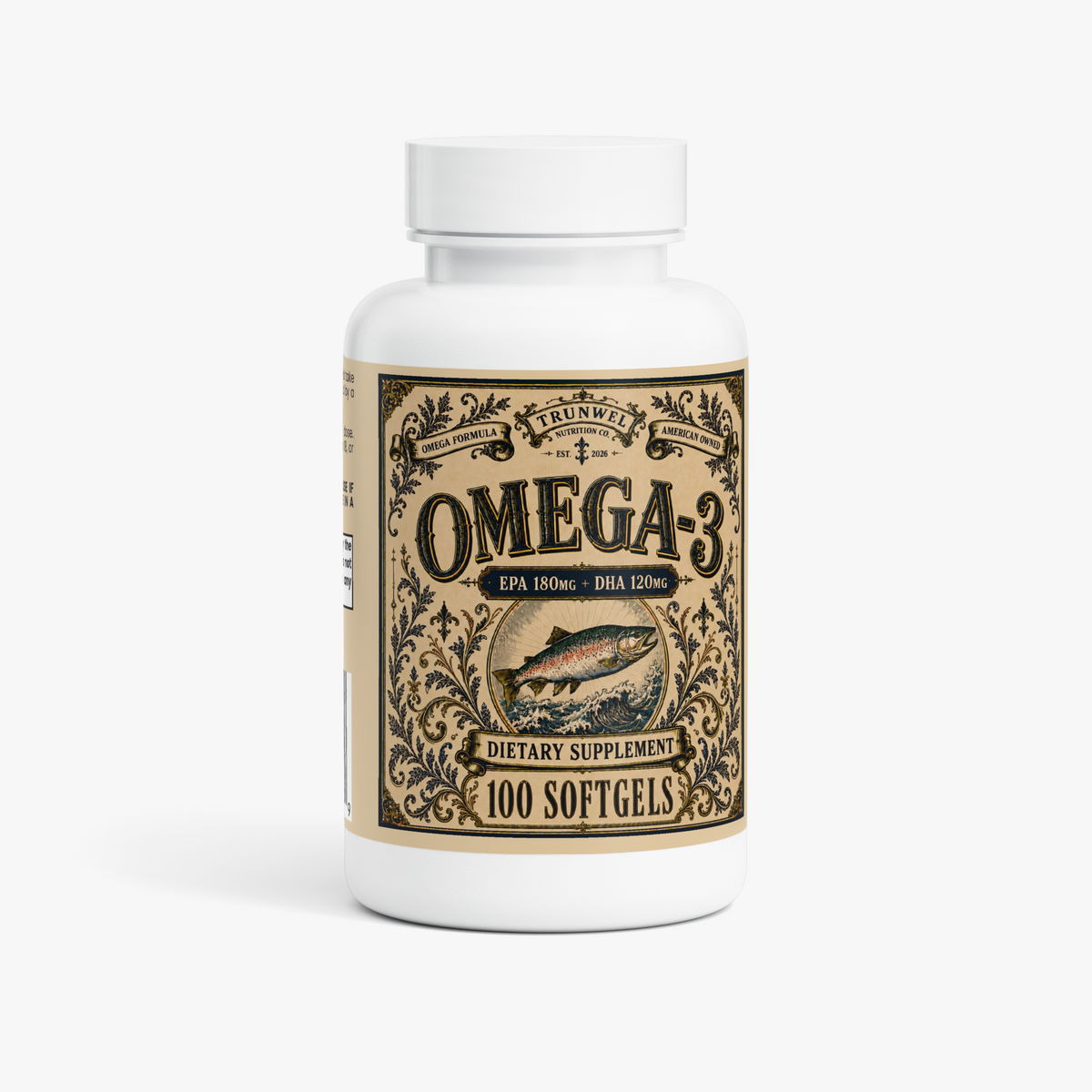
The current TRUNWEL Omega-3 Fish Oil product information lists 180 mg EPA and 120 mg DHA per softgel, with 100 softgels per bottle. Adding the two listed amounts gives 300 mg combined EPA and DHA per softgel.
| Label detail | Current TRUNWEL information | What it tells you |
|---|---|---|
| EPA | 180 mg per softgel | The listed amount of one fatty acid |
| DHA | 120 mg per softgel | The listed amount of a different fatty acid |
| EPA + DHA | 300 mg per softgel | The sum of the two listed amounts |
| Bottle quantity | 100 softgels | How many softgels the bottle contains |
The 300 mg calculation is label arithmetic. It is not a claim that this amount is the right dose for every person or that it reproduces a clinical trial. Read the current bottle before use, since packaging and formulas can change.
Total fish oil and EPA plus DHA answer different questions
Where a label supplies a total fish-oil amount, keep that number separate from the EPA and DHA amounts. Do not automatically add the oil total to its listed components: that may double-count material already included in the total. Likewise, do not assume an unlisted remainder is additional EPA or DHA.
If a product page does not disclose a total oil weight, leave that field blank in your comparison rather than estimating it from capsule size or a photograph. Ask the brand for clarification. A transparent comparison can acknowledge a missing detail; it should not fill the gap with a familiar number from another product.
Compare price on the same basis
Price per bottle is useful for your budget, but it is incomplete when bottle quantities and serving sizes differ. First divide the price by the number of labeled servings. If you also compare the cost of a fixed amount of EPA plus DHA, calculate it using the actual listed values and clearly identify the unit.
These calculations compare quantity and price, not clinical value. A lower cost per milligram does not establish better tolerance, testing, suitability or effectiveness. Consider allergens, softgel ingredients and the directions alongside the numbers. TRUNWEL’s listed formula contains fish oil and a gelatin softgel, which matters if you avoid fish or gelatin.
Research doses are not instructions to multiply softgels
Studies can investigate different populations and formulations, including prescription products. A study’s dose cannot automatically become a recommendation for an over-the-counter supplement. For example, the large VITAL trial did not show a significant reduction in its primary composite cardiovascular outcome with its studied marine omega-3 intervention. That result is a reason to read study outcomes precisely rather than turn the word “omega-3” into a blanket disease-prevention promise.
If a clinician has recommended a particular EPA and DHA amount, show them the complete label and ask how it fits that advice. Do not adjust a routine simply to imitate a paper, and do not substitute a supplement for prescribed treatment. The TRUNWEL sample report includes EPA and DHA measurements, but its heavy-metal figures are marked “report only,” the testing legend describes periodic testing, and no peroxide, anisidine or TOTOX results are provided. Those omissions mean the summary does not establish an oxidation-quality claim or complete testing of every current lot.
A practical comparison checklist
- Record the exact product and serving size.
- List EPA and DHA separately, then add only those two amounts if a combined figure is useful.
- Keep total oil weight distinct from its components.
- Compare bottle quantity and cost using the same unit.
- Review fish allergens, gelatin, other ingredients and storage directions.
- Ask for the scope of any testing claim instead of assuming it covers every possible quality measure.
Frequently asked questions
Is fish oil the same as omega-3?
No. Fish oil is one source of omega-3 fatty acids. The individual EPA and DHA amounts show more detail about a particular formula.
Does a larger milligram number mean a better product?
Not by itself. First establish what the number measures, how many softgels it covers and whether the formula fits your needs.
Does the EPA and DHA total tell me how much to take?
It tells you what the listed softgel or serving supplies. Personal recommendations require context such as diet, medications and medical advice.
Explore the product
View TRUNWEL Omega-3 Fish Oil and its current ingredient information. For additional ingredient guides, visit the TRUNWEL Research Library.
Related omega-3 research
- Omega-3 Fish Oil Benefits: What Human Research Shows
- EPA vs. DHA: Understanding the Two Fish Oil Fatty Acids
- Omega-3 Dosage: Reading EPA and DHA per Softgel
- Best Time to Take Fish Oil: Food, Timing and Routine
- Fish Oil Side Effects and Safety: What to Check
For a comparison of ingredients and serving sizes, see the Omega-3 Fish Oil Guide.
Sources
- NIH Office of Dietary Supplements: Omega-3 Fatty Acids, Consumer Fact Sheet.
- Manson et al. Marine n-3 Fatty Acids and Prevention of Cardiovascular Disease and Cancer. New England Journal of Medicine, 2019.
- TRUNWEL Omega-3 Fish Oil product label and product information, checked November 15, 2026.
Written by Justin Roame. Educational content from TRUNWEL, which sells the product discussed. This article has not been presented as an independent product review or a medical review. It is not medical advice. Consult a qualified healthcare professional about individual supplement use.